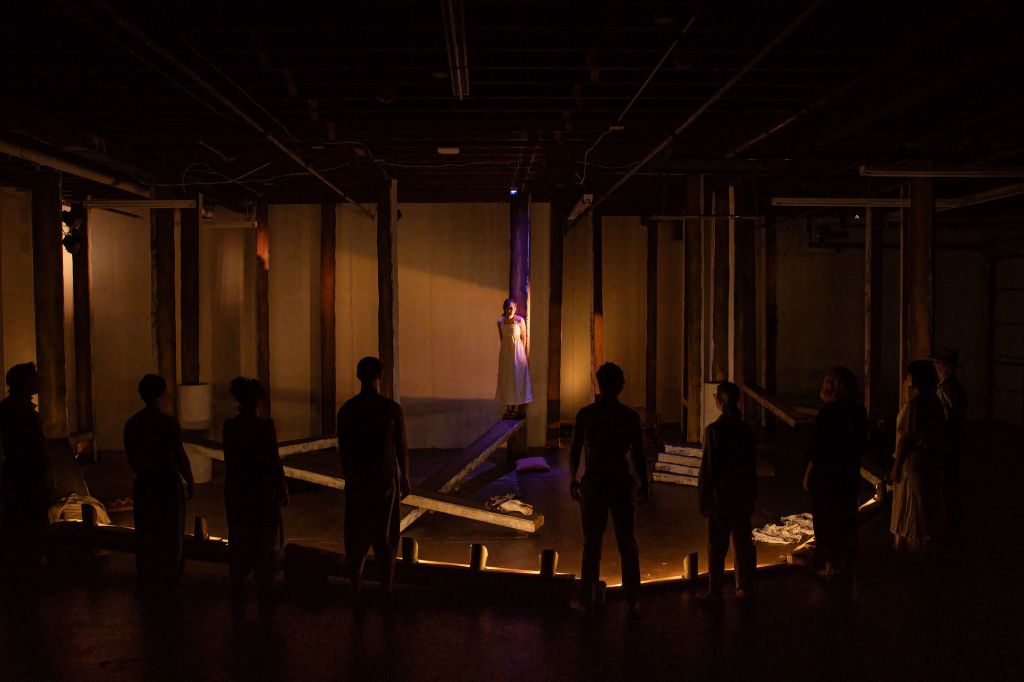
In the premiere production of Anton Chekhov’s The Seagull, performed in 1896 in St. Petersburg, there was one gunshot and one death. In director Grant Sorenson’s radical new adaptation of The Seagull, being staged in a warehouse space in Minneapolis’s North Loop through November 14th, there are three gunshots and three deaths, not including the titular bird. This is not business as usual.
You don’t need these quasi-spoilers — which I’ll truly spoil later, with a requisite bold warning in advance for those who wish to skip — to know this is not your great-grandfather’s Seagull. From the moment you buy your ticket to this production, on an artfully designed website with muted colors and striking fonts (no stock ticket vendor interface here); to when you enter this theater, a nontraditional venue in the same building as Butcher and the Boar; to when you’re handed one of the programs, which are a single piece of textured cardstock, calling to mind a wine bar’s bottle list, the Modern Rep is consciously melting down and reforming your perceptions of this well-worn play.
The whole reason for the Modern Rep’s existence is to shock the theatrical canon back to life for today’s changing audiences. The theater company, which Sorenson as artistic director officially launched this year, “believes that classic texts are not relics to be preserved, but living works meant to be interrogated, disrupted, and brought vividly into the present moment,” per its mission statement. Sorenson understands that engaging potential theatergoers today doesn’t start when the lights go down, it starts where Minnesotans spend an increasingly large chunk of their time: swiping on their phones.
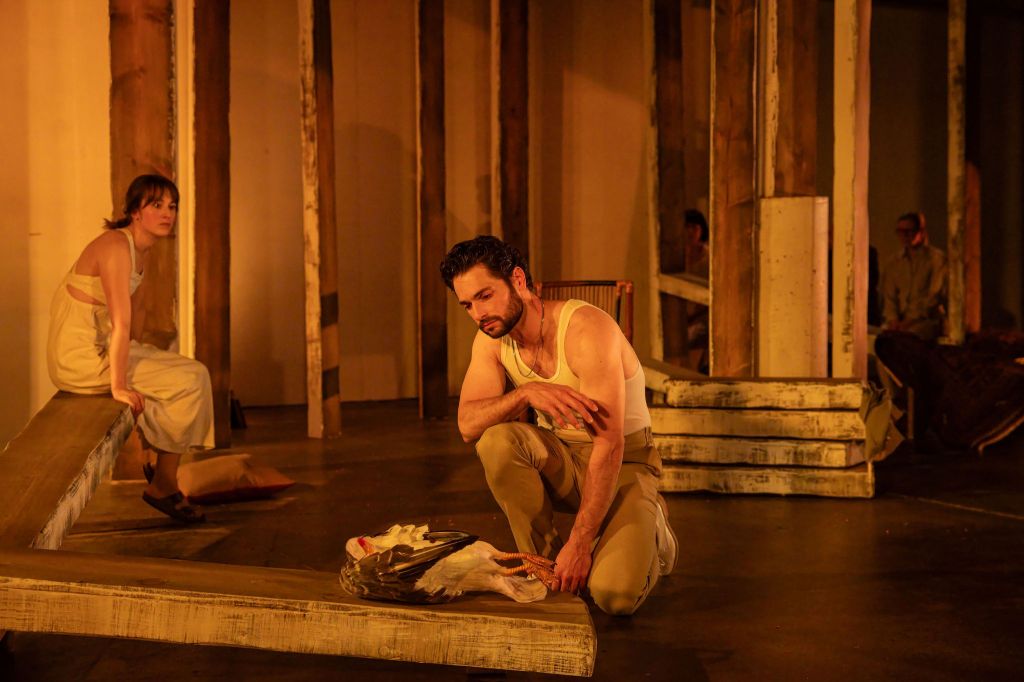
No one would accuse Sorenson of preserving this 130-year-old Russian play. Sure, we still have bourgeois woes during a summer at the lake in 1890s Russia: Konstantin Treplev (David Michaeli) is trying to make his way as a playwright and woo neighbor Nina Zarechnaya (Linds Esch) in the process, yet his fading actress mother Irina Arkadina (Christina Baldwin) can’t find it in herself to support his avant-garde approach, even in his low-stakes play that is being staged in the woods of her brother Pyotr Sorin’s (Patrick Bailey) estate.
Yet, these woods, as with the rest of the locations, are depicted by plain wooden beams, painted white on some sides and arranged haphazardly on the floor of the theater that makes up the stage, with some attached at low angles like ramps for the actors to sit on, scramble up and totter across. (Sorenson is also billed as the scenographer; scenic construction is by Sam Poppen.)
The rest of the ensemble is given their time to shine, from estate manager Ilya Shamrayev (Bruce Abas) to his wife Polina Andreyevna (Vanessa Gamble), and their daughter Masha (Lana Breheney) who pines for Konstantin despite constant rebuffs, to school teacher Semyon Medvedenko (Leo Rossmiller) who pines for Masha, and Boris Trigorin (Steve Mallers), a successful yet jaded writer who has taken up with Arkadina but pines for Nina.
Yet, the local doctor, Yevgeny Dorn, is now a woman, “Yevgenia Dorn,” played with sagacity by Laura Esping. So instead of one insinuation that sometimes sneaks into The Seagull (that Masha is Dorn’s daughter, not Shamrayev’s), in his adaptation, Sorenson has swapped in a more contemporary secret (a furtive lesbian fling between Polina and Dorn).
It’s remarkable how modern The Seagull feels in Sorenson’s hands. Forget all the aesthetic trappings — including the purple wig on Masha, hippie garb on Nina, and trackpants on Konstantin that suggest Gen Z — the story itself, delivered by this accomplished troupe, feels like it’s speaking to America today, not the Russian Empire of the 19th century. Medvedenko and Masha open the play bickering about who has it worse: the poor teacher who can’t afford basic necessities, or the middle-class layabout who self-medicates her depression. Konstantin’s play imagines a world where all living things have gone extinct, yet it’s not taken seriously by most of the adults. Many of the characters yearn for fame and approval, but can’t grasp that true fulfillment may not follow in the wake of those pursuits.
There’s a more potent message that comes through in this Seagull for me, though.
It begins with a simmer, when Konstantin enters in Act 2 wearing a ski mask, trackpants, and no shirt, his muscular torso exposed, carrying a bloody seagull he has just shot in an effort to impress Nina. (This is the first extra gunshot, as it is not normally heard in the play.) In a traditional production, this moment could be awkward: a young man realizing his attempt to win over a woman is, in truth, deranged. Instead, the moment is charged with the potential for more violence.
Michaeli’s dominant physique in relation to Esch’s delicate frame is echoed later on, when Mallers’s Trigorin begins his seduction of Nina with his brawny arms bared. When she tells him about Konstantin shooting the seagull, Trigorin jots down a note for a new story: All her life a young girl has lived on the shore of the lake. She loves the lake, like a seagull. But a man happens along, sees her, and, having nothing better to do, destroys her. Mallers doesn’t speak these lines as a threat, but the atmosphere of this production, including the slightly claustrophobic sense imbued by the herbal cigarettes smoked by actors throughout the show, gives it that flavor.
Warning: The rest of this review contains major spoilers for this production.

When modern theatermakers “disrupt” classic shows, they often skew toward progressive ideals. Gender-bending Shakespeare. Colorblind Founding Fathers. When My Fair Lady was most recently staged on Broadway, and then made its way to the Twin Cities, the ending was altered slightly so that Eliza leaves Henry in the end (aligning with the source material, George Bernard Shaw’s 1913 play Pygmalion), seeing as how he has apparently not changed his misogynist ways. In this Seagull, the opposite happens.
In Act 4, two years after the initial action, Trigorin has completed his conquest of Nina, then left her to rot — she gets pregnant, then loses the baby. We find ourselves back at the lake house in winter. Sorin is sick, so everyone is returning despite the snow. Konstantin has finally found some success as a writer, though he publishes popular fiction — not his avant-garde passions — under a pseudonym. Then, at night, when he is alone, Nina shows up at his door.
It all comes spilling out. Konstantin loves her, he says he kisses the ground she walks on. Nina still loves Trigorin, despite everything. Konstantin is still unfulfilled by his writing, despite now being published. Nina meanwhile has found true purpose in acting. She believes in herself and her calling, and says she is not afraid of life, no matter how painful.
In the play as Chekhov wrote it, this is where they part, and on a feminist note: Nina leaves, maybe to her ruin, maybe not, but nonetheless in full ownership of her life. Konstantin, however, walks offstage, then shoots himself, which no one notices but Dorn.
In this production, a line Nina speaks to Konstantin — something to the effect of, Why do you say that you have kissed the ground I walked on? You should kill me rather — is taken as a request. After Nina starts reciting part of his play that was performed at the beginning of the show, which Esch injects with a newfound knowledge of grief, Konstantin shoots her, then points the gun at his temple and pulls the trigger in full view of the audience. Michaeli twitches after he hits the floor before going limp.
The effect of moving this brutal scene onstage is clear enough: whereas Chekhov kept all the dramatic action offstage as a counter to the melodramatic plays of his time, and to focus on the consequences of actions instead of the sensational deeds themselves, Sorenson has given The Seagull the HBO treatment, where violence is amped up to match our desensitized times. It’s a powerful moment, no doubt, and well staged.
But the effect of having Konstantin kill Nina is less clear. It certainly invites discussion. Is he merely acquiescing to her request to end it all, a position he feels forced into because of his love for her? Does Nina know her ruin at the hands of Trigorin is irreversible, and so despite her belief in herself, she doesn’t believe there will ever be forgiveness from the cruel world around her?
For me, those discussions are eclipsed by the fact that Nina’s agency in the play has been discarded. Her life is ended by a man with a gun. As such, a major feminist element is actively removed from this Seagull — which, sadly, may be a way of bringing this show “vividly into the present moment,” considering certain statistics show male violence against women is on the rise once again.
Full Transparency: I bought my own ticket for The Seagull.
Top photo: Molly Jay Photography
The Seagull
The Modern Rep
901 North 3rd Street, Suite 156
Minneapolis, MN 55401
October 22 – November 14, 2026
Read more and buy tickets here



Leave a Reply