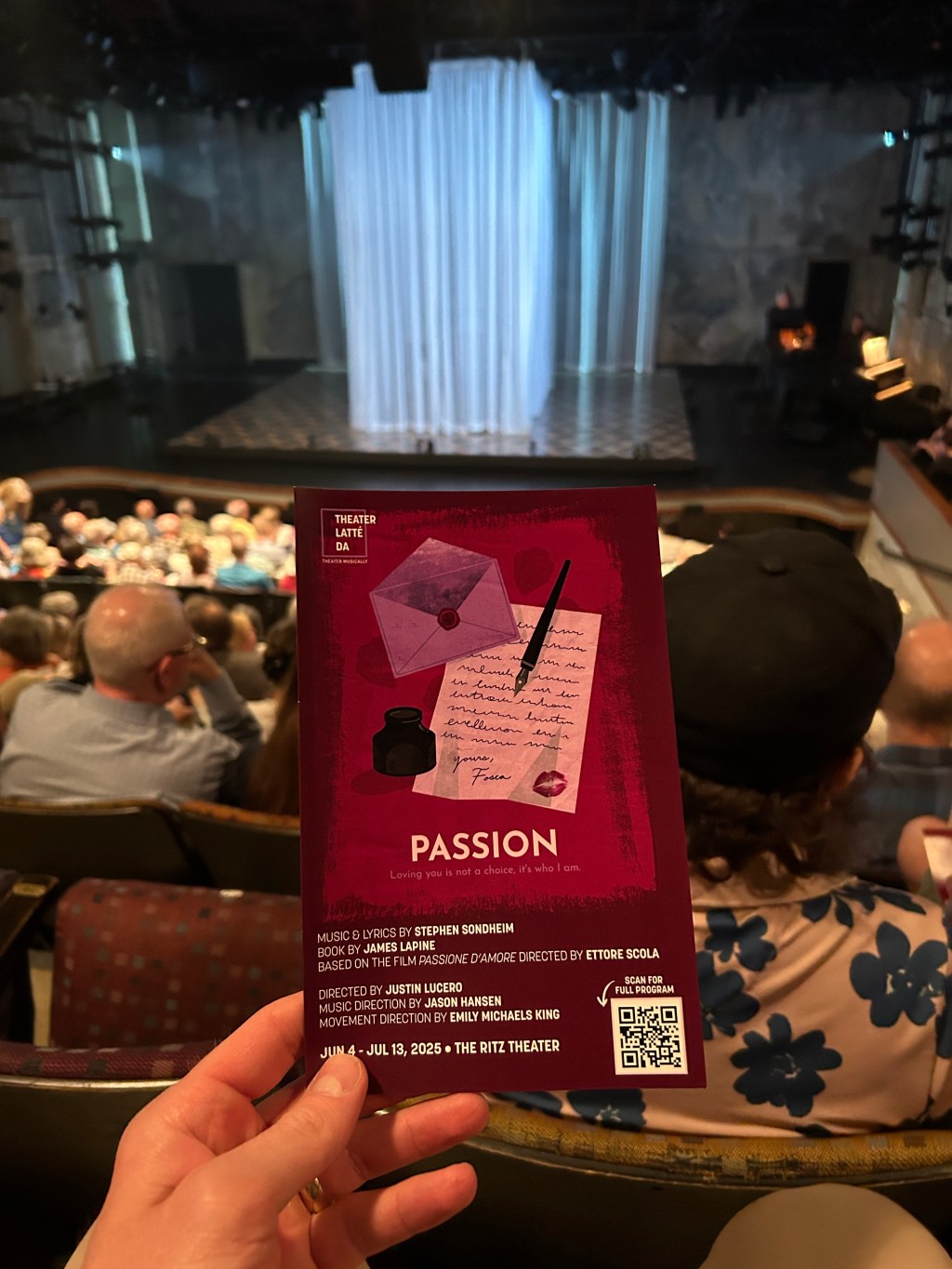
Love triangles make for superb musical theater. Curly, Laurey and Jud in Oklahoma! The Phantom, Christine and Raoul in The Phantom of the Opera. Giorgio, Clara and Fosca in Passion. I’m here today to talk about the one about a manipulative, pitiful outcast with the voice of an angel who seduces a winsome rising star who’s in love with another. That’s right, we’re talking Passion (wait, did you think I was going to say Phantom?), which Theater Latté Da is staging through July 13.
Director Justin Lucero calls the musical by Stephen Sondheim and James Lapine “one of the most divisive works in the American musical canon” in his program note. I’ve heard this sentiment before, but Lucero, who is also Latté Da’s new artistic director, could have fooled me with this production. Instead of an esoteric Sondheim puzzle, his reconceived Passion feels like a diamond that has been unearthed, dusted and polished. For 100 minutes, he turns this theatrical gem around in his hand, the many facets mesmerizing until the end.
That’s not to say I’m blind to the contentious subject matter that Lapine (who wrote the book) and Sondheim (music and lyrics) put on the page, based on the 1981 movie Passione d’Amore and set during Italy’s Risorgimento period.
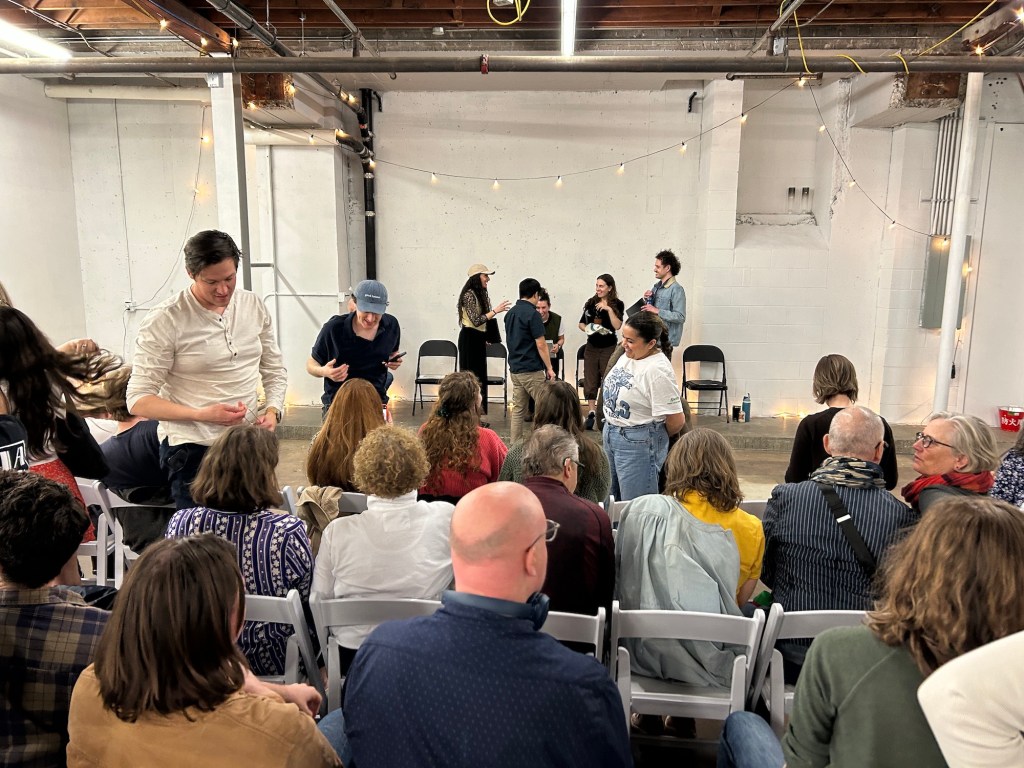
Giorgio is a handsome and intelligent soldier who is deeply in love with the beautiful, and older, Clara. Their love story, as they sing in the opening number, is “a kind of happiness no one really knows.” But he is soon shipped off from Milan to a desolate military outpost where his only companions are a group of listless soldiers and his commanding officer’s cousin, Fosca, a sickly and unsightly shut-in who quickly latches onto Giorgio. None of his rebuffs slow her advances, not even expressing his love for Clara. Fosca is an “annoying,” “manipulative” “stalker” — at least according to a few audience members at a post-show talkback I attended.
That’s not how I felt at all. Erin Capello, who recently coaxed a few tears from my ducts as Jenna in Waitress at Artistry, plays Fosca here in a performance that will make you wince at her gall, certainly, but also envy her vulnerability. In between full-throated gasps and moans that reveal her advanced illness, she bares her soul to Giorgio in songs that can’t help but melt his coldness towards her, just as Capello’s stirring resonance can’t help but melt us in the audience — speaking for myself, at least.
Fosca will test your limits as this love triangle begins to implode, but even in her first song, “I Read,” which comes after Giorgio has lent her some books upon arriving at his new post, Capello has already communicated the key to unlocking an empathetic Fosca and moving beyond the so-called divisiveness of the musical: When she sings “I do not dwell on dreams / I know how soon a dream becomes an expectation / How can I have expectations? / Look at me,” we understand that it’s not just her homely appearance that gives her no hope for the future, it’s that her unpredictable illness means she may die any day. How would you behave if every day could be your last? Wouldn’t you cling onto a glimmer of hope for love, no matter how faint?
It’s not just Capello’s heady blend of desperation and devotion that kept me entranced for the entirety of this one-act musical. Lucero has placed the action amidst a constantly shapeshifting maze of curtains: When we meet Giorgio, he’s in a bed surrounded by floor-to-ceiling gauze; when he’s transferred, the curtains wall off the officers from Fosca; when the two unlikely lovers meet in her room, he opens them to let the moonlight fall on her. These diaphanous screens suggest Giorgio’s memories which serve as the framing device for Lucero’s production, but also the fragility of secrets we keep from others and ourselves. It all comes to light eventually. And when the staging comes to light — that is, when the curtains are thrust to the side in favor of a glorious vista — make sure to hold onto your arm rest. Things are about to get real.
The quietly masterful scenic and lighting design is by Paul Whitaker. Though the component parts are humble — curtains and a raised playing space on the stage — they’re still able to clearly delineate the settings: the bedrooms, the dining room, the overgrown garden of a derelict castle. What remains opaque are the answers Sondheim and Lapine seek about the nature of love. This musical doesn’t offer any tidy lessons, but this staging offers plenty of surprises, which I much prefer.
One of the production’s best surprises for me was the lush sound that music director Jason Hansen was able to achieve with just five players: Ryan Golden on winds, Greg Hippen on double bass, Renata Steve on violin and Diane Tremaine on cello, with conductor Hansen on piano. I was underwhelmed at the music direction in Latté Da’s Cinderella earlier this season (where Hansen served as music supervisor, with Wesley Frye as music director), and disappointed in Lucero’s direction in his first foray as the company’s new artistic director, but Passion has renewed my confidence that Lucero is fully capable of continuing, and extending, the ambitions of this groundbreaking theater.
So what of the other two legs in this love triangle? Isa Condo-Olvera’s Clara is bright-eyed and crystal-clear in her love for Dylan Frederick’s Giorgio, thoroughly convincing us of her love for him and also her young child, who is not Giorgio’s offspring, a fact that must be dealt with eventually. Frederick doesn’t quite convince us of this initial love; his embraces and caresses of Condo-Olvera don’t match the sweet words he sings with clarity and precision — no easy feat in a Sondheim score that’s as tricky as ever — which makes Fosca’s pull on him less audacious than it could be. Yet, his best moments also come as he opens himself to the idea of Fosca’s love, which helps make the case for a relationship that audiences might otherwise root against.
While the Giorgio-Clara-Fosca conundrum offers most of the dramatic tension here, the rest of the cast does admirable work filling out the story (and Sondheim’s sound). Phinehas Bynum, Bradley Greenwald, Riley McNutt, Eric Morris, Rodolfo Nieto and Adán Varela are the poor unfortunate souls stuck at the barracks with the shrieking Fosca. Morris as Colonel Ricci, Fosca’s cousin, plays the unwitting go-between with aplomb; and Nieto’s deep voice and stoic demeanor go a long way in helping ground us in this 19th-century Italian setting.
Maybe you’ll be like the audience members at my talkback and have lots of asterisks to amend to your opinion of this show. But with Lucero at the helm and Capello singing Sondheim at his most passionate, I hope you will, like me, find room for this production among your pantheon of great musical theater love triangles.
Full Transparency: I bought my own ticket to Passion.
Passion
Theater Latté Da
The Ritz Theater
345 13th Ave NE
Minneapolis, MN 55413
June 4 – July 13
Read more at Theater Latté Da



Leave a reply to mphtheatregirl Cancel reply