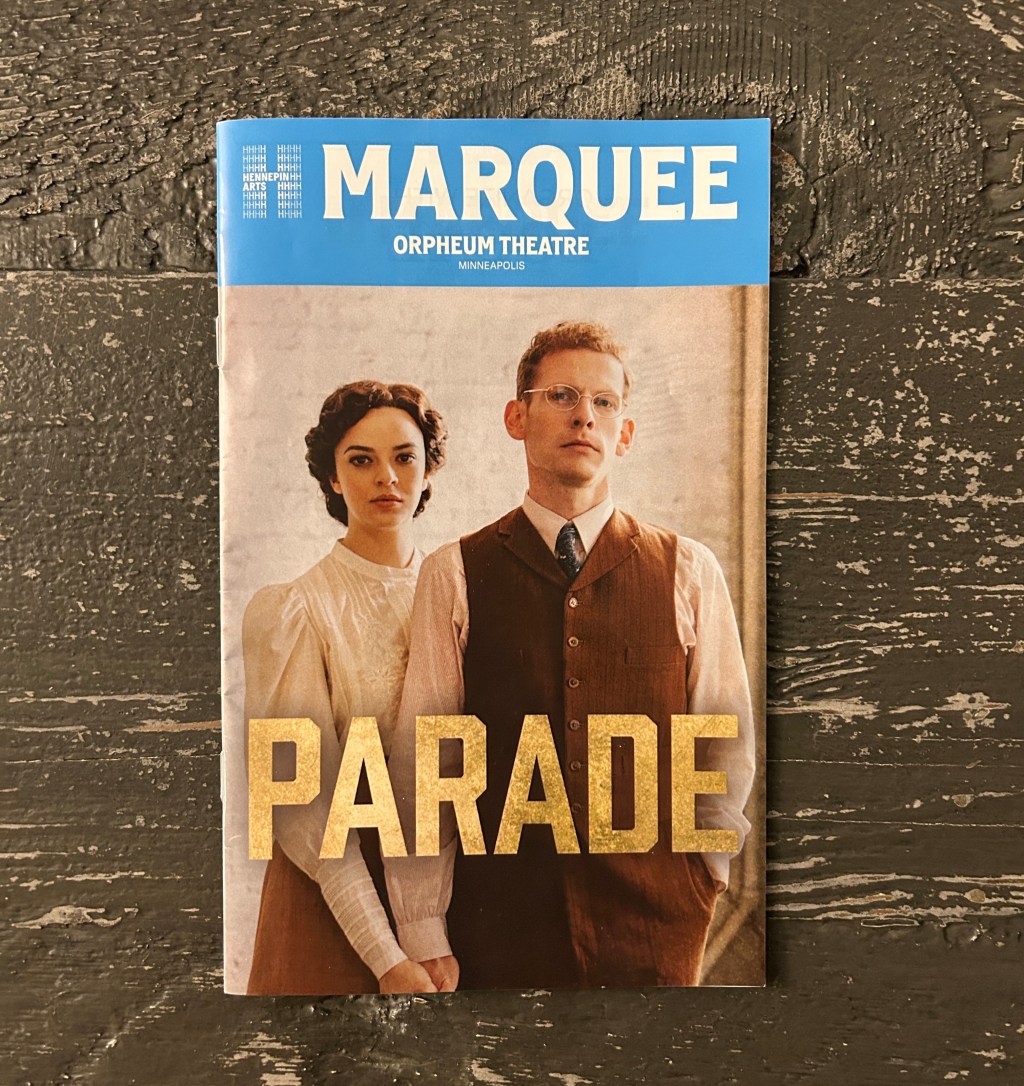
When I went to buy tickets for Parade at the Orpheum Theatre, the first stop on the national tour for this Tony-winning revival, I found two orchestra seats being resold on Ticketmaster well under the original price. In fact, they were the cheapest available in the entire theater — even cheaper than the back row of the balcony. When my wife and I arrived at row AA on Friday night, we found out why: we were seated in the middle of a school group of 13-or-so-year-olds. Ah. Maybe a few kids dropped out at the last second and the frazzled organizers were just trying to get some money back.
It makes sense why teachers would want to bring young (but not too young) students to Parade. The musical, which is based on the real-life trial and eventual lynching of Jewish American Leo Frank in the 1910s, is a compelling reminder of the deep-rooted prejudices we’re still reckoning with today, specifically antisemitism and racism, in that order. Thanks largely to Max Chernin’s performance as Leo — sung with crystalline clarity and thoroughly convincing as a Brooklyn Jew in the “foreign land” of Georgia — that lesson is presented in an unforgettable way.
Yet, the original construction of this show and especially its new direction under Michael Arden ultimately stop this Parade at that signpost. What we have here is indeed a lesson — a history lesson that revives the horrors of the past in graphic fashion and highlights their relevance to the modern era, but doesn’t achieve the higher artistic ambitions toward which it strives.
I should note that this is my first time seeing Parade, which won two Tony Awards in 1999 on its first outing (notably for Best Original Score, which went to then-28-year-old composer and lyricist Jason Robert Brown) and two more in 2023 for this production (including Best Revival and Best Direction). I should also admit that, due to the show’s critical acclaim, especially of this recent staging, I expected to be overawed by this musical. Instead, I found myself wondering what ardent admirers see that I don’t.
At least when it comes to the subject matter, we can all agree that the story of Leo Frank is one that deserves to be told, and re-told, and re-told again down the generations. (A fact only cemented by the small neo-Nazi demonstration outside the show in New York City two years ago.) In creating this musical, Brown, book writer Alfred Uhry and co-conceiver Harold Prince have introduced countless audience members over the last three decades to a story of American antisemitism that they may have never otherwise heard. However, elevating historical events is one thing; creating a successful piece of theater is another.
The story of Parade begins outside Atlanta in the town of Marietta. The Civil War is raging and a Confederate soldier is going off to fight for “a way of life that’s pure.” Fast forward 50 years and it’s 1913, the Union has won, but the Southerners are loath to accept that — in fact, they’re throwing a Confederate Memorial Day parade. It’s on this day that a 13-year-old girl named Mary Phagan is raped and murdered, and Leo, the manager at the factory where Mary works, is accused of the crime. The second half of the first act — nine songs in total — takes place during the trial when fabricated testimony is presented against Leo, fomented by vile antisemitic tropes, leading to a guilty verdict. In the second act, Leo’s wife Lucille (Talia Suskauer), helps bring the false accusations to light, and the death sentence is commuted to life in prison. But a town desperate for vengeance refuses to accept that, and they lynch Leo.
It’s bleak subject matter, but it’s made unnecessarily bleaker by focusing on the trial and forgetting to focus on Leo and Lucille, who are allegedly the heart of the show. When Lucille sings “You Don’t Know This Man,” a condemnation of a reporter who prints inventions about Leo to sell papers ahead of the trial, she’s also communicating the inner dialogue of the audience: We don’t really know this man, either, as he’s only given one significant song to introduce himself before a litany of townsfolk are paraded around the courtroom by prosecutor Hugh Dorsey (Andrew Samonsky) to tell horrible lies about Leo violating and killing a young girl.
This preference for the documentary half of docudrama, rather than exploring the inner hopes and struggles of the main characters, is this show’s main failing. But this proclivity is also found in Arden’s new staging, which not only projects the time and location of certain scenes on the stage (a nice touch that keeps us grounded), but also displays photos of the real people from history (an unnecessary addition) and even zooms in on newspaper headlines throughout (a hokey effect that makes it feel like museum-grade theater). The audience is smart enough to understand the weight of this history without the addition of historical documents.
Breaking the musical apart into individual songs, the artistic merits of Parade are much clearer. Brown’s music is skillful and often beautiful, even in such a dark show, and his lyrics are of the Stephen Sondheim school where rhymes are layered and illuminating. But like the musical that followed this one, The Last Five Years, the individual parts are greater than the whole.
Thankfully, the cast here is largely excellent. Besides the standout performance from Chernin, there’s the young Jack Roden who plays Frankie Epps, a friend of Mary, whose grief-turned-rage cannot help but be felt by the audience; Ramone Nelson as ex-con Jim Conley would certainly bring down the house in his two solos, but the specifics of his character — who fabricates a story about helping Leo cover up the alleged murder — stymies the applause; and Griffin Binnicker imbues Tom Watson, an anti-Jewish writer, with chilling fervor. Unfortunately, while Suskauer’s singing is as gorgeous as any I’ve heard at the Orpheum, she struggled with the Southern accent required of her character, which only compounded the feeling that the main characters are not adequately realized in this show.
While much care has obviously gone into the making (and reconceptualization) of this musical, and many audience members feel it is an essential experience, I can’t help but see all the ways in which the show fails to live up to its subject matter. That even includes the content warning that’s being shared by Hennepin Arts and other theaters for this tour: They warn ticket buyers that the musical “includes themes of racism, anti-semitism and historical connections to white supremacy,” but there’s no mention that this show graphically details the murder and rape of a child, and ends with real photos of a lynching projected onto the back wall. Where is the care in preparing audience members for that?
Full Transparency: Going forward, I will note if I receive free tickets to a performance in exchange for a review. I bought tickets to Parade.
Parade
Orpheum Theatre
910 Hennepin Ave.
Minneapolis, MN 55403
January 21 – 26, 2025




Leave a reply to marksgreenfield Cancel reply