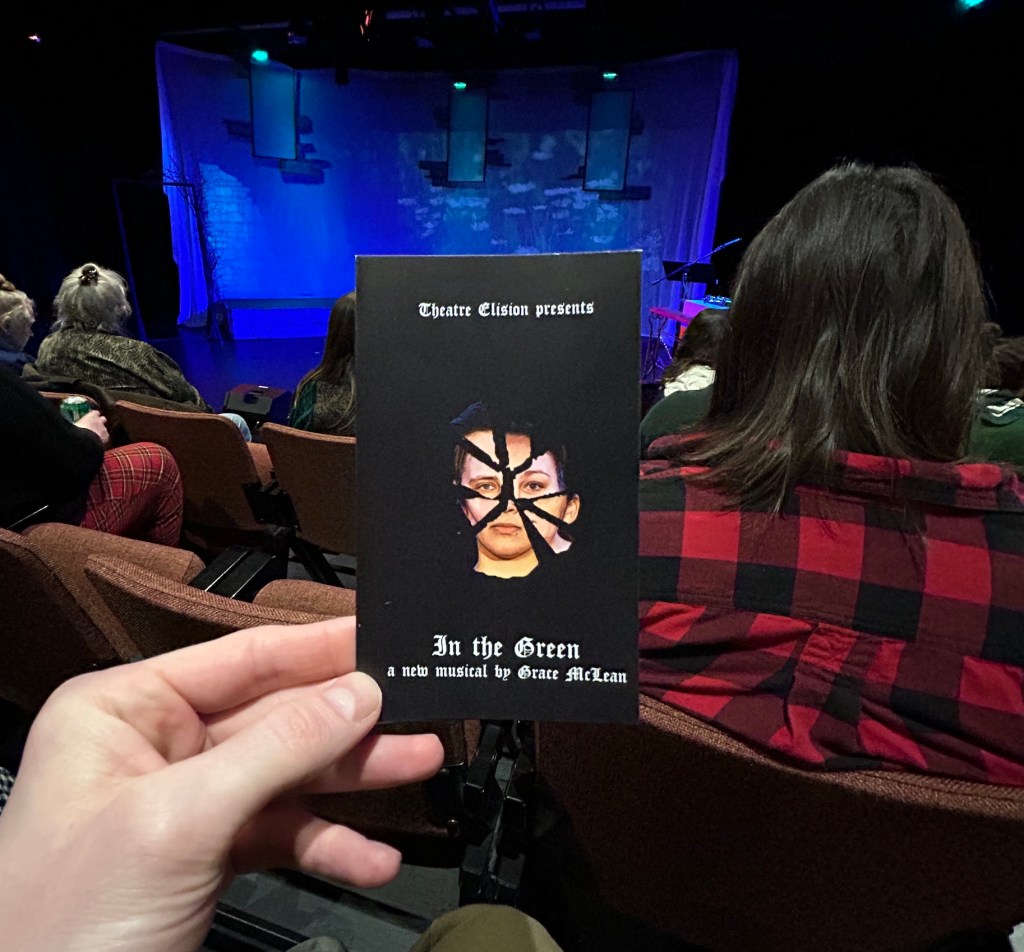
A simple scrim stretched across a stage. Three boxes ascending in height. Three soft bins stuffed with fabric. A doorframe. A microphone. A wooden podium with a tabletop vocal looper. These humble implements are most of what you’ll see on stage at Theatre Elision’s production of In the Green. Maximalist, immersive theater, this is not.
Still, nine songs into this musical in a black box theater in Crystal, I felt a kinship with a 12th-century German nun. However improbable it may seem right now, I think you will, too.
Let’s start with the nun in question. That would be Hildegard von Bingen, who lived between 1098 and 1179. If this particular Catholic saint isn’t on your radar, music director Harrison Wade, who’s also on keys, gives a crash course on her many groundbreaking achievements as a composer, healer, and woman in the church before this 90-minute musical starts. Which is helpful, because the show barely touches on these biographical highlights. Instead, In the Green focuses on a part of Hildegard’s life we know less about: the 30 or so years she was locked in a cell in a monastery, from roughly the age of 8 to 38.
This may sound like creator Grace McLean was trying to build a cell of her own to try and compose her way out of: an inscrutable subject trapped in an actionless plot. Yet, McLean — who wrote the book, music, and lyrics ahead of the show’s off-Broadway debut in 2019 — has taken cobwebbed history and refashioned it into a stirring experience that sounds like both the 12th and the 21st century, while exploring the crucibles women have braved across time, and continue to brave.
While this is a one-act musical, it is not a one-woman musical. Hildegard is enclosed in her cell with Jutta von Sponheim (played by Christine Wade), who is an anchoress, a radical form of religious devotion that involves shutting yourself away to focus on prayer, enlightenment, and self sacrifice. For all intents and purposes, she may as well be dead; in the early song “Death Ceremony,” young Hildegard is given to the church by her parents as a human tithe (or tax) and joins her new mentor in this renunciation of normal life. “You were not born to live,” sings Jutta, “you were born to be forgiven.”
What follows is less a meditation on finding spiritual enlightenment, which is what Jutta wants, than it is the story of two women who must throw off the shackles of religious and societal oppression to heal their earthly trauma. For all its antiquated touches, including some of Hildegard’s own compositions worked into the score, In the Green’s themes feel surprisingly, depressingly current.
We know Hildegard is hiding some traumatic experience at the outset of the show, as McLean has interestingly split the role into three parts: her eye (Annie Schiferl), which “shouldn’t have seen”; her hand (Abilene Olson), which “shouldn’t have led”; and her mouth (Deidre Cochan), which “shouldn’t have said.” Jutta is convinced she can heal this broken girl and make her whole again, as she herself was once broken. But as it turns out, the fifth character in this show, Shadow (Emily Hensley), will prove the mentor may not know as much as she purports to.
Not that we, the audience, or Hildegard would know of Jutta’s vulnerability. The anchoress’s supposed wisdom is both shown in Wade’s domineering attitude towards little Hildegard — she commands her to constantly dig a hole in their cell, and renounce food and sleep — and illuminated through McLean’s musical choices. Many of Jutta’s songs are created using the aforementioned vocal looper, with Wade singing, beatboxing, and even vocalizing the sound of spitting, which she records on the spot and then cues back up to repeat while she starts in on another vocal track.
Instead of feeling out of sync with the subject matter, this ingenious musical concept feeds into it: Wade’s varied vocal stylings layered on top of each other feel at times medieval, haunting, and primal. For those who are more interested in traditional Broadway-style belts, Wade’s got those covered, too, which are more impressive for their proximity in Theatre Elision’s cozy playhouse. It will not surprise you to see Wade is also the vocal director on this show.
For the most part, though, McLean’s music is less concerned with the catchy melodies normally employed in musical theater. That’s not to say it doesn’t have precedent in the theatrical canon: Shiferl, Olson, and Cochan are often tasked with speaking and chanting along with the music, instead of singing, calling to mind Elizabeth Swados’s 1978 musical Runaways, about runaway children in New York City. (These musicals also both deal with young people facing situations they aren’t equipped to handle. As it turns out, Swados was one of McLean’s teachers.)
Elsewhere, there are moments throughout In the Green that call to mind Lin-Manuel Miranda’s style with a very specific rap-like cadence that fans of Hamilton will recognize. The ending specifically, after Hildegard is eventually released, feels like an imitation of Eliza’s coda in that musical — it could have been lopped off, along with two short sections played behind the scrim when Hildegard is being interred and then set free, and In the Green would have been better for it.

If a musical that’s not chiefly concerned with beautiful (or even agreeable) music doesn’t sound like your idea of a fun night out, maybe it’s time to go back to the moment I felt like I had forged a bond between 21st-century me and 12th-century Hildegard. It came when, after being confined in her dark cell for a while, the reluctant oblate sang about feeling a “cinnamon stick ray of sunlight fall through the window.”
When that tune, called “Sun Song,” proceeded, I felt the weight of what director Lindsay Fitzgerald has created come crashing down on me. I wasn’t fully conscious of it before, but the repetition in the lyrics, the yearning of the movement embodied in the three Hildegards (from movement coordinator Madeline Wall), and the unease imbued in the music (I don’t think a drummer’s skill has ever felt more essential to a piece of theater than Miles Whealy’s efforts here), had combined to form the feeling of a cell more solid than any set designer could have built. So when Olson held up her hand to touch the sunbeam, Hildegard’s unknowable mind seemed to bubble up under the surface of my skin.
It’s well-honed moments like these, surreptitiously assembled while you’re focused on the story at hand, that make Theatre Elision’s production of In the Green a visceral, vital story. The disparate elements of the musical may seem humble, or archaic, or odd, but woven together by this team there is enlightenment to be had that will stay with you well beyond the walls of the cell, and of Elision Playhouse.
Full Transparency: I bought my own ticket to In the Green.
In the Green
Theatre Elision
Elision Playhouse*
6105 42nd Ave. N.
Crystal, MN 55422
*Just an 18-minute drive from downtown Minneapolis, for those who’ve never been.
February 19th – March 7th
Read more and buy tickets here


Leave a comment